
Aviator Strategies — Bankroll Management & Expected Value
There's no shortage of "Aviator strategies" online promising steady income. We break down what's actually a legitimate risk-management tool versus marketing myth, and explain the math behind every approach.
Why "guaranteed systems" don't exist
The probability a round reaches multiplier M is roughly RTP / M (see the full breakdown on our "RTP & Fairness" page). The higher your cash-out target, the less often a round reaches it, but the payout when it does is proportionally larger. The two factors always balance out to exactly the house edge, which is why no combination of target and bet frequency produces positive expected value.
Popular tactics: what they really are
| Tactic | Idea | Actual effect |
|---|---|---|
| Low fixed cash-out (x1.2–1.5) | Frequent small wins | Reduces bankroll volatility, doesn't change expected value |
| Dual bet (one low, one high target) | Splits risk between a conservative and an aggressive target | A volatility-management tool, not an EV boost |
| "Martingale" (doubling the bet after a loss) | Recover past losses with one lucky bet | Requires exponentially growing bankroll and hits table limits — the risk of busting the bankroll outweighs the potential gain |
| "Pattern spotting" from round history | Looking for patterns in past multipliers | Doesn't work — rounds are independent (Provably Fair RNG) |
A separate category is paid "predictors" and Telegram "signal" channels posing as working strategies. That's not a tactic, it's a scam. See why these tools can't technically work in "Myths & Scams".
The bankroll-management principles here aren't specific to one game. The same math holds for Aviator's alternatives, which we cover in "Aviator vs JetX vs Lucky Jet vs Spaceman".
Bankroll management: what you actually control
Expected value can't be changed, but bankroll risk management stays entirely in the player's hands. Set a session limit in advance: the amount you're willing to spend on entertainment in one sitting. Split your stake, using a small fraction of your bankroll per round, say 1–2%, so one bad streak doesn't end your session instantly. Set a limit on time, not just money, since fatigue and excitement lower decision quality. And if your operator offers auto-stop on loss or win, it's worth using so decisions aren't made in the heat of the moment.
A worked session example
Here's a simple illustrative example; the numbers are just to show the principle, not a recommendation on amounts.
| Parameter | Value |
|---|---|
| Session limit (bankroll for one sitting) | $20 |
| Stake per round (1.5% of bankroll) | $0.30 |
| Rounds until bankroll runs out with zero wins in a row | ≈ 66 rounds |
| Expected session loss at 97% RTP (average, not a guarantee) | ≈ $0.60 (3% of $20) |
This math isn't meant to predict a session's outcome. Any single result is random and can land far above or below the average. The point is understanding the scale of possible swings in advance, so you don't increase your stake fraction mid-session trying to chase a loss back.
The psychology of play: why tilt is riskier than the math
Negative expected value isn't actually the biggest practical risk for most players. Far more losses come from tilt, the emotional state after a losing streak where a player raises their bets to recover faster and breaks limits they set for themselves beforehand. This is a psychological pattern, not a property of the game itself, but in practice it's what turns a predictable -3% into much larger losses in a single session.
- Wanting to immediately win back a loss with a bigger bet.
- Playing past your planned time limit — "just one more round".
- Irritation or excitement that makes it hard to think clearly about decisions.
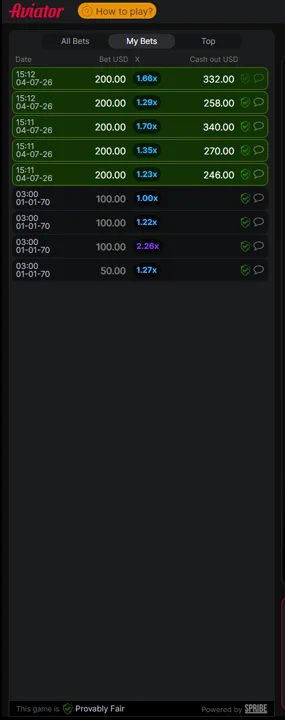
Tilt has a mirror image: overconfidence after a winning streak like this one. A run of good cash-outs can feel like it confirms a "system" is working, but each round remains statistically independent (see our RTP & Fairness page). Treating a streak as proof of a working method is the same gambler's fallacy in reverse, and it often leads to raising bets right before variance turns the other way.
Testing a tactic on the demo
Before applying any tactic to real bets, it's worth testing how it feels psychologically on the Aviator demo. That won't change expected value, but it will help you understand your own reaction to a losing streak with zero financial risk.
FAQ
Is there a strategy that guarantees a win in Aviator?
No. With an RTP below 100%, every cash-out strategy has negative expected value over the long run. That's a mathematical fact, not a matter of luck or skill.
Does martingale work in Aviator?
Technically, doubling your bet can recover a previous loss on one successful round. But over a losing streak, the bankroll needed grows exponentially faster than most players can afford, and table limits cap the maximum bet anyway.
Can you predict the next multiplier from round history?
In a Provably Fair system, each round is independent and determined cryptographically before it starts, so past results have no bearing on future ones.
What fraction of my bankroll should I bet per round?
The general risk-management principle is a small, fixed fraction, say 1–2% of your session limit, so a losing streak doesn't end your session in just a few rounds. This is about managing volatility, not changing expected value.
What is tilt, and why is it riskier than the game itself?
Tilt is the emotional state where, after losses, a player raises their bets to recover faster and breaks their own limits in the process. Tilt, not a negative RTP by itself, is usually what causes a player to lose an entire planned budget in one sitting.
Does auto cash-out help avoid tilt?
Auto cash-out and auto-stop-on-loss lock in a decision in advance, before an emotionally charged streak of rounds begins, so they can reduce the risk of impulsive decisions. They don't, however, change the game's underlying expected value.